The Microbiome Management seriesPillar 6 of 6Humic and fulvic acids
Somewhere in your feed room there is a tub you bought on a good explanation. It sounded right. It may even have worked, for a while. So when a label says humic acid, fulvic acid or carbon, the fair question is not whether the explanation sounds convincing. It is what has actually been shown, in which animal, and how far that reaches the horse standing in front of you.
This article is our answer to that question for our own ingredients, and it is written to be checked. Where the evidence is solid, we say so. Where it comes from other species, we say which. Where it does not yet exist for horses, we say that too.
What humic and fulvic acids are
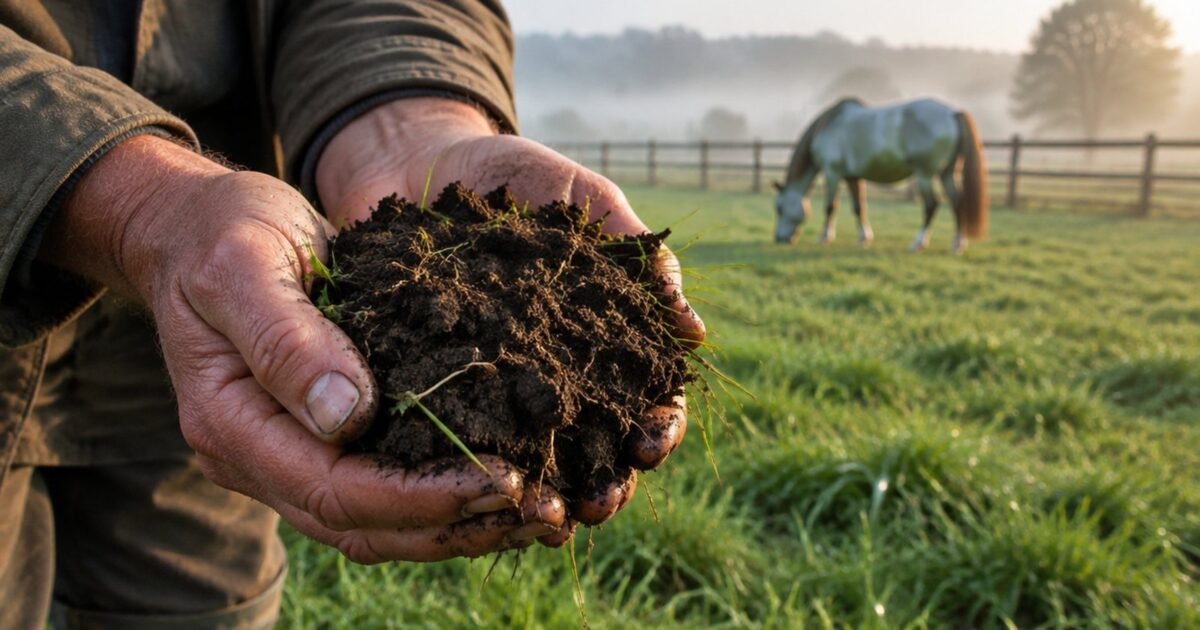
Pick up a handful of dark, rich soil and you are holding them. Humic and fulvic acids are the carbon compounds that form as plant and microbial material breaks down over a very long time, in soils, peat, natural waters and old organic deposits.1
“Humic acid” is not one molecule with one formula. It is a fraction of that material, separated in a laboratory by how it behaves in acid and alkali, and “fulvic acid” is the smaller, more soluble fraction that stays dissolved when the humic fraction drops out.1,2
That laboratory origin matters in the feed room. Two products can both print humic acid on the label and be supplying different materials, from different sources, processed differently, at different amounts. The International Humic Substances Society keeps reference samples so that researchers can compare like with like, and says plainly that its methods exist for comparison, not as a stamp on anyone’s manufacturing process.2 On a label, the words are where the questions start, not where they end.
Our companion article Humic acid for horses: Chemistry, proposed roles, and research limits goes further into the humic fraction.
What we mean by bioavailable carbon
Your horse already eats a great deal of carbon. Fiber, starch, sugar, protein and fat are all carbon compounds, and the hindgut microbes ferment the fiber into the volatile fatty acids the horse absorbs for energy.3 Nobody needs to add carbon to a horse in that sense, and a label that implies otherwise is muddling you.
The carbon Humequine is built on is a different thing. Bioavailable carbon, as we use the term, is the carbon held in humic and fulvic compounds, the same carbon compounds found in nutrient-rich soil. It is not a sugar and it is not fiber. It forms in the ground rather than in the plants growing out of it, which is why we hold the position that most rations, even well-managed ones, supply little of it. The equine microbiome: How the hindgut helps your horse digest forage sets that definition beside the rest of the ration.
What has been shown about it, and what has not, is the fair next question. In soils and sediments, microbiologists have shown that some microorganisms grow by passing electrons to humic substances, the way other organisms pass them to oxygen.4 That is one way a humic compound can take part in microbial growth without being eaten, and it is why we take seriously the idea that these compounds can fuel it. The feeding evidence comes from animals given these compounds, and that is where we go next.
What fuels the equine microbiome? Carbon, fiber, and microbial nutrition looks at the whole carbon picture, including the soil a grazing horse takes in with the grass.
What Humequine says it does, in one sentence
Here is the sentence we use. It describes the mechanism the formula is designed around, in the language of what each ingredient does in the gut environment:
The sentence we use
Humequine fuels the growth of beneficial bacteria with bioavailable carbon, humic acid binds to unwanted compounds supporting natural detoxification, and fulvic acid binds to nutrients and water molecules for enhanced absorption and hydration.
Three functions, held to one standard. Each rests on chemistry shown outside the horse: in soil for the first, in the laboratory for the other two. Responses to feeding have been measured in other species, most directly for the first and third. Taking the functions one at a time against that standard is the honest way to read our label.
Three functions, one standard
| Function | Chemistry shown | Measured in fed animals |
|---|---|---|
| Function oneFuels the growth of beneficial bacteria | Chemistry shownIn soil: some microorganisms grow by passing electrons to humic substances.4 | Measured in fed animalsGut communities shifted in hens and broilers; in a rumen model, ammonia fell.5,6,7 |
| Function twoBinds to unwanted compounds | Chemistry shownIn the laboratory: a mixture of large compounds with many binding sites.8 | Measured in fed animalsBinding described in the review literature; no feeding response cited.8 |
| Function threeBinds to nutrients and water molecules | Chemistry shownIn the laboratory: the smaller, more soluble fraction.1,2 | Measured in fed animalsGrowth and feed conversion in broilers and pigs. Hydration not measured.9,10 |
Function one: feeding the microbes
The claim that humic and fulvic compounds support the microbial community comes from animals whose gut communities were measured after eating them.
In 252 laying hens, adding fulvic acid to the feed shifted the balance of the gut community: one bacterial group rose, another fell, and the hens laid slightly more eggs and broke fewer of them.5 In 360 broiler chickens, fulvic acid changed the abundance of several bacterial groups alongside better growth, and the response depended on the dose.6 In a laboratory model of the rumen fed a hay and concentrate diet, humic substances lowered ammonia production step by step as the dose went up, while the overall community structure was largely unchanged and the main fermentation measures did not move.7
Function one: what was fed, what was measured
252
Laying hens
FedFulvic acid in the feed
What movedOne bacterial group rose, another fell. Slightly more eggs, fewer broken.
360
Broiler chickens
FedFulvic acid, at several doses
What movedSeveral bacterial groups shifted alongside better growth. The response depended on the dose.
Lab
Rumen model, hay and concentrate
FedHumic substances, rising doses
What movedAmmonia fell step by step. Community structure and the main fermentation measures largely unchanged.
Read those three together and the picture is honest rather than tidy. Gut communities do respond when these compounds are fed. The response is not the same in every species, at every dose or in every setting, and a rumen model that changed one thing and left the rest alone belongs in the record beside a hen house where several things changed. This is what “known to support gut microbiome health” rests on: measured responses in fed animals, studied across livestock species.5,6,7,8
Function two: binding
Humic acid is a mixture of large, complex compounds with a great many sites where other molecules can attach. That chemistry is the basis of the second function: humic acid binds to unwanted compounds, supporting natural detoxification. The review literature on humic substances in animal feeding describes that binding activity.8
Because the evidence is the binding itself, we describe this function by what the ingredient does in the gut environment.
Function three: nutrients and water
Fulvic acid is the fraction small enough and soluble enough to move readily, and its function is to bind to nutrients and water molecules for enhanced absorption and hydration.
The animal evidence here is production evidence. In 720 broilers, fulvic acid at moderate doses increased weight gain and raised the activity of the digestive enzymes that break down starch, fat and protein, with no extra gain from the highest dose.9 In 216 growing pigs, diets with fulvic acid improved growth and feed efficiency, with the response varying by feeding phase.10 Those are the endpoints a poultry or pig producer cares about: more from the same feed. They are consistent with animals getting more from what they eat.
Function three: production evidence
720
Broiler chickens
FedFulvic acid, three doses
What movedMore weight gain and higher activity of the enzymes that break down starch, fat and protein at moderate doses. No extra gain from the highest.
216
Growing pigs
FedDiets with fulvic acid
What movedBetter growth and feed efficiency, varying by feeding phase.
Binding to nutrients and water molecules is the chemistry, and it is established. Absorption is the outcome it points to, and the growth and feed conversion measured in birds and pigs fit it. Hydration has not been measured in these studies. Fulvic acid for horses: What nutrient and hydration claims need to show sets out the steps between a broiler and your horse.
Why the same ingredient does not always do the same thing
One more study belongs here, because it is the kind a brand usually leaves out.
In 350 newly weaned pigs, researchers fed a humic acid product to animals drinking either clean water or water with sodium sulfate added, a common problem in well water. On clean water the humic acid group grew better than the other diet groups. On the sulfate water it grew worse than they did.11 The same ingredient, two different results, decided by something in the environment that had nothing to do with the label.
Same ingredient, two results
Clean water
Grew better
The humic acid group grew better than the other diet groups.
Water with sodium sulfate
Grew worse
The same humic acid group grew worse than they did.
Same pigs, same product, different water
That is not an argument against humic acid. It is the whole argument for Microbiome Management. What a microbial community can do with any input depends on the conditions it lives in: what reaches it, how acidic it is, how much water is moving through. A supplement does not float above those conditions. It lands in them. Microbiome Management for horses: A framework for Digestive Stability is where we set out why we start with the conditions rather than the ingredient.
Where the horse evidence stands
There is a record of humic acids being given to horses by mouth. A 1999 summary report from the European Committee for Veterinary Medicinal Products describes oral use of specified humic acid preparations in horses, ruminants, pigs and poultry, notes that very little is absorbed from the gut, and records low toxicity in the animal studies it reviewed.12 That is a useful thing to know about history and tolerance. It is not a trial or an approval of Humequine or of any modern formulation.
Beyond that, here is where we stand. We searched for a peer-reviewed, controlled trial of a humic or fulvic formulation in horses that measured a digestive outcome, and we did not find one. There is no such trial of the Humequine formula. New research could change that, and this article will be updated if it does. Today the evidence that bears on using these compounds in horses comes from other species. What owners observe is a different kind of information.
Owner observation deserves respect, and it deserves its proper place. Skippy is a 29 year old paint pony whose owner had managed persistent digestive issues for five years. Within about a week of starting the Humequine formula, she noticed a meaningful change. Two and a half months on it had held, with no further recurring symptoms. Individual results may vary. This testimonial reflects one owner’s experience and is not a guarantee of results. It is one horse, told as one horse, which is why we ask you to record what changed around your horse and not only what changed in him. That habit is Microbiome Management in practice, and Digestive Stability in horses: How to tell whether a change holds is built for it.
What would settle it
The study that would settle it is a randomized, blinded trial of a known formulation in horses, with a result decided in advance that matches the claim, sampled where the claim lives and repeated before anyone calls it settled. It is also the yardstick worth holding up against any equine supplement claim.
Not every gut word is a gut-environment question. Colic describes abdominal pain with many different causes, including impaction, obstruction and displacement, and it is a question for your veterinarian, not the feed room.14
The yardstick for any equine supplement claim
A known product
The source of the humic and fulvic material, how it was measured, the daily amount and everything else in the formulation.
A fair comparison
Horses given the formulation against horses that were not, assigned at random, scored by people unaware of which was which.
A result decided in advance, matching the claim
A change in manure consistency for a claim about digestion, not a blood marker standing in for it.
Sampled where the claim lives
A manure sample describes the end of the tract, not the stomach.
Repeated
In other horses, on other diets, before anyone calls it settled.
From ingredient research to product claims: Reading equine supplement evidence takes the yardstick further.
Reading the label, including ours
The words humic and fulvic on a label are the start of a conversation with the manufacturer. These are the questions worth asking, and we are happy to be asked them.
- Where does the material come from, and how is it processed into the ingredient in the bottle?
- What do the percentages describe: the raw ingredient, a dried fraction, or the product as fed?
- How much is in a daily serving? A percentage without a serving amount tells you nothing about what the horse receives.
- What else is in it? Carriers, minerals and other actives belong in the same conversation.
- What is tested batch by batch, for composition and for contaminants, by which method and which laboratory?
- What supports the amount and the duration recommended for a horse like yours?
For the record, here is the start of ours. Humequine is a daily liquid, made in Canada, built on humic and fulvic acid, and given by following the label directions. Ask us the rest. We would rather you asked than assumed.
A certificate of analysis answers some of these. It tells you what a laboratory found in one batch. It does not tell you what the product will do in a horse. For a horse on medication or on a carefully balanced ration, take the label to your veterinarian or nutritionist.
Evaluating a humic or fulvic supplement for horses: Source, composition, and quality works through the list.
Where this sits in Microbiome Management
Microbiome Management is the practice of supporting the environment that beneficial bacteria need, so the community already in your horse can grow and stabilize. The outcome it works toward is Digestive Stability, built daily. The Microbiome Management Framework organizes that practice around the biological environment first, then the microbiome, then stability, then the whole horse, and it is broader than any one ingredient. Forage, water, routine, transitions and observation are in it whether or not a product is.
The Microbiome Management Framework
- Support the biological environmentWhere Humequine sits
- Support the microbiome
- Support Digestive Stability
- Support whole-body condition and resilience
Humequine sits at the first stage, the biological environment: it changes what reaches the microbes. The evidence in this article was measured further along, in what gut communities and the animals themselves did when fed these compounds. Humic and fulvic acids are naturally occurring compounds known to support gut microbiome health, on the strength of what has been measured in fed animals, and Humequine is formulated to support equine gut health.
Microbiome Management starts with the environment, and so does Humequine: an environment-first formula for an environment-first framework. Forage, water and routine shape the conditions inside the horse every day, and Humequine fuels the growth of beneficial bacteria with bioavailable carbon inside those same conditions. Where Humequine fits within a Microbiome Management program is the article about the product itself.
From Humequine
Humequine Digestive Stability Formula
A daily liquid concentrate formulated with humic and fulvic acid. Tasteless and odorless, it is added to feed or grain. Made in Canada, for horses only.
See the formulaThese statements have not been evaluated by the Food and Drug Administration. This product is not intended to diagnose, treat, cure, or prevent any disease.
Frequently asked questions
What are humic and fulvic acids?
Humic and fulvic acids are the carbon compounds that form as plant and microbial material breaks down over a very long time, in soils, peat, natural waters and old organic deposits. Humic acid is not one molecule with one formula: it is a fraction of that material, separated in a laboratory by how it behaves in acid and alkali. Fulvic acid is the smaller, more soluble fraction that stays dissolved when the humic fraction drops out.
What is bioavailable carbon?
At Humequine, bioavailable carbon means the carbon held in humic and fulvic compounds, the same carbon compounds found in nutrient-rich soil. It is not a sugar and it is not fiber. It forms in the ground rather than in the plants growing out of it, which is why we hold the position that most rations, even well-managed ones, supply little of it.
How does Humequine work?
Humequine fuels the growth of beneficial bacteria with bioavailable carbon, humic acid binds to unwanted compounds supporting natural detoxification, and fulvic acid binds to nutrients and water molecules for enhanced absorption and hydration. Each function rests on chemistry shown outside the horse, and feeding responses have been measured in other species, most directly for the first and third.
What does the research show about fulvic acid in animals?
In 252 laying hens, fulvic acid shifted the balance of the gut community and the hens laid slightly more eggs and broke fewer (Xiao and colleagues, 2022). In 360 broilers it changed several bacterial groups alongside better growth, depending on the dose (Liu and colleagues, 2024). In 720 broilers, fulvic acid at moderate doses increased weight gain and digestive enzyme activity (Mao, 2019). In 216 growing pigs, it improved growth and feed efficiency (Bai and colleagues, 2013).
Has humic or fulvic acid been studied in horses?
A 1999 summary report from the European Committee for Veterinary Medicinal Products describes oral use of specified humic acid preparations in horses and other species, notes that very little is absorbed from the gut, and records low toxicity in the animal studies it reviewed. We searched for a peer-reviewed, controlled trial of a humic or fulvic formulation in horses that measured a digestive outcome and did not find one. Today the evidence that bears on using these compounds in horses comes from other species.
Why can the same feed ingredient give different results?
Because it lands in the conditions of the gut it is fed into. In 350 newly weaned pigs (Flohr and colleagues, 2014), a humic acid product grew pigs better than the other diets on clean water and worse than them on water with sodium sulfate added. What a microbial community can do with any input depends on what reaches it, how acidic it is and how much water is moving through.
What should I ask about a humic or fulvic supplement for my horse?
Where the material comes from and how it is processed; what the percentages describe; how much is in a daily serving; what else is in it; what is tested batch by batch, by which method and laboratory; and what supports the amount and duration recommended for a horse like yours.
What would a good equine supplement study look like?
It would say exactly what was fed, compare horses given the formulation with horses that were not, assigned at random and scored blind, decide in advance what counts as a result and match it to the claim, sample where the claim lives, and be repeated in other horses on other diets before anyone called it settled.
Does a certificate of analysis show that a supplement works?
No. A certificate of analysis tells you what a laboratory found in one batch. It answers some questions about composition, but it does not tell you what the product will do in a horse.
References
- International Humic Substances Society. What are humic substances? humic-substances.org/what-are-humic-substances-2/
- International Humic Substances Society. Isolation of IHSS samples. humic-substances.org/isolation-of-ihss-samples/
- University of Maryland Extension. Teaching Basic Equine Nutrition Part II: Equine Digestive Anatomy and Physiology. extension.umd.edu (PDF)
- Lovley DR, Coates JD, Blunt-Harris EL, Phillips EJP, Woodward JC. Humic substances as electron acceptors for microbial respiration. Nature. 1996;382:445 to 448. doi.org/10.1038/382445a0
- Xiao G, Liu S, Yan X, Yang Y, Qi Q, Feng X, Gong L, Zhang H. Effects of fulvic acid addition on laying performance, biochemical indices, and gut microbiota of aged hens. Frontiers in Veterinary Science. 2022;9:953564. doi.org/10.3389/fvets.2022.953564
- Liu L, Yang N, Chen Y, and colleagues. Effects of fulvic acid on broiler performance, blood biochemistry, and intestinal microflora. Poultry Science. 2024;103(2):103273. doi.org/10.1016/j.psj.2023.103273
- Terry SA, Ramos AFO, Holman DB, McAllister TA, Breves G, Chaves AV. Humic substances alter ammonia production and the microbial populations within a RUSITEC fed a mixed hay and concentrate diet. Frontiers in Microbiology. 2018;9:1410. doi.org/10.3389/fmicb.2018.01410
- Islam KMS, Schuhmacher A, Gropp JM. Humic acid substances in animal agriculture. Pakistan Journal of Nutrition. 2005;4(3):126 to 134. doi.org/10.3923/pjn.2005.126.134
- Mao Y. Modulation of the growth performance, meat composition, oxidative status, and immunity of broilers by dietary fulvic acids. Poultry Science. 2019;98:4509 to 4513. doi.org/10.3382/ps/pez281
- Bai HX, Chang QF, Shi BM, Shan AS. Effects of fulvic acid on growth performance and meat quality in growing-finishing pigs. Livestock Science. 2013;158:118 to 123. doi.org/10.1016/j.livsci.2013.10.013
- Flohr JR, and colleagues. The effects of sodium sulfate in the water of nursery pigs and the efficacy of nonnutritive feed additives to mitigate those effects. Journal of Animal Science. 2014;92(8):3624 to 3635. doi.org/10.2527/jas.2013-7436
- European Agency for the Evaluation of Medicinal Products, Committee for Veterinary Medicinal Products. Humic acids and their sodium salts: Summary report. EMEA/MRL/554/99-FINAL. February 1999. ema.europa.eu (PDF)
- Ericsson AC, Johnson PJ, Lopes MA, Perry SC, Lanter HR. A Microbiological Map of the Healthy Equine Gastrointestinal Tract. PLOS ONE. 2016;11(11):e0166523. doi.org/10.1371/journal.pone.0166523
- UC Davis Center for Equine Health. Colic: A pain in the gut. 2024. cehhorsereport.vetmed.ucdavis.edu/news/colic-pain-gut
This article is for education and is not veterinary or medical advice. If you have a significant concern about your horse, talk to your veterinarian or an equine nutritionist.